DOOH Venue Classification Guide
Return to Resources Hub
DOOH Venue Classification Guide
These classifications help buyers understand where screens are placed, what audiences they reach, and how campaigns can be targeted.
This guide explains how venue types are structured and how to classify screens correctly so they are easier for advertisers to discover and activate.
Why Venue Classification Matters
- Advertisers target relevant environments
- Programmatic buyers discover inventory faster
- Campaigns perform more effectively
- Networks increase the value of their screens
The DOOH Venue Classification Structure
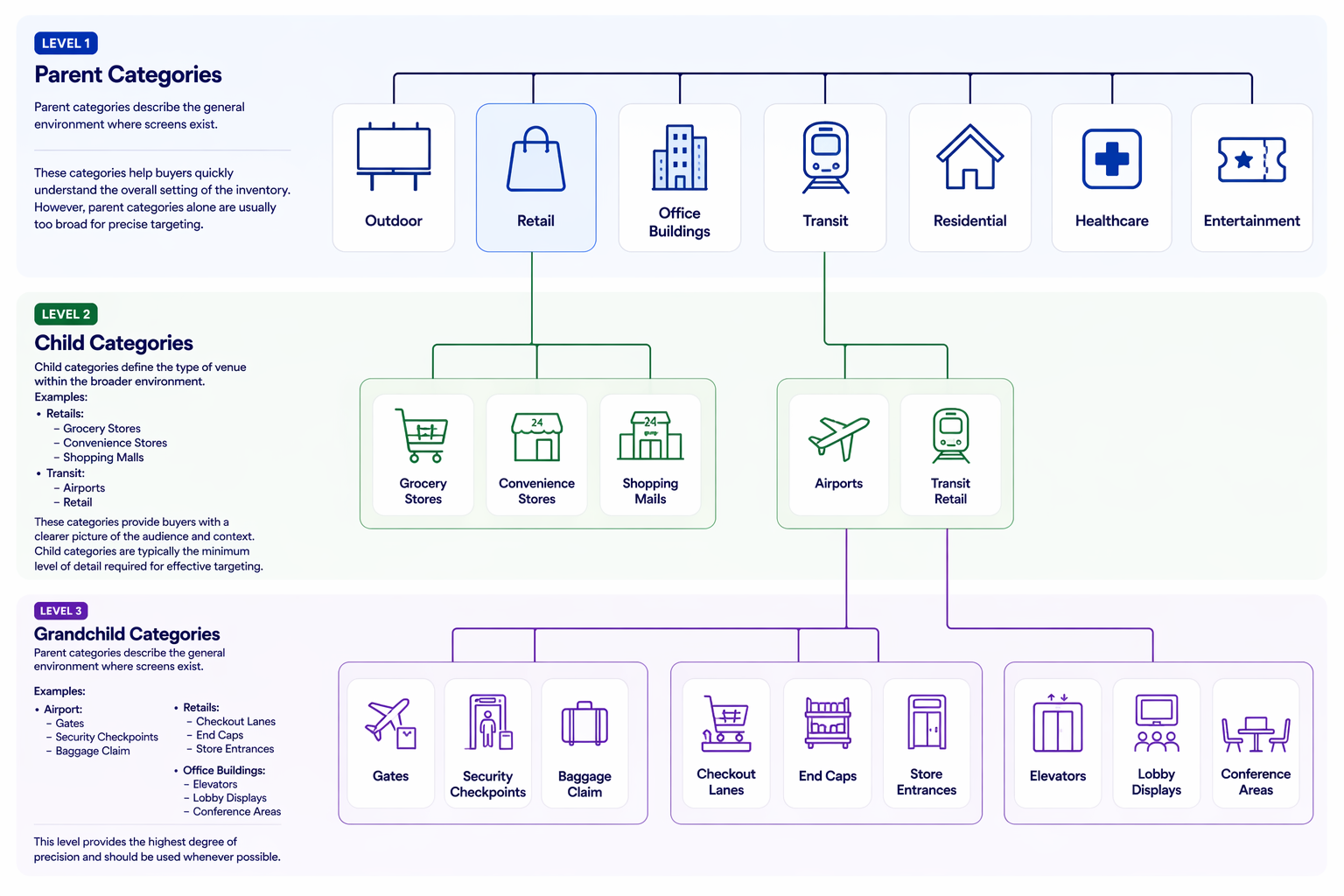
Venue types are organized in a three-level hierarchy that becomes progressively more specific.
This structure allows buyers to filter inventory from broad environments down to specific placements.
Level 1: Parent Categories
Parent categories describe the general environment where screens exist.
Outdoor
Retail
Office Buildings
Transit
Residential
Healthcare
Entertainment
These categories help buyers quickly understand the overall setting of the inventory.
However, parent categories alone are usually too broad for precise targeting.
Level 2: Child Categories
Child categories define the type of venue within the broader environment.
Examples:
Retails:
Grocery Stores
Convenience Stores
Shopping Malls
Transit:
Airports
Retail
These categories provide buyers with a clearer picture of the audience and context.
Child categories are typically the minimum level of detail required for effective targeting.
Level 3: Grandchild Categories
Parent categories describe the general environment where screens exist.
Airport:
Gates
Security Checkpoints
Baggage Claim
Retails:
Checkout Lanes
End Caps
Store Entrances
Office Buildings:
Elevators
Lobby Displays
Conference Areas
This level provides the highest degree of precision and should be used whenever possible.
Best Practices for Classifying Screens
Use the Most Specific Category Available
If a grandchild category exists, use it. More precise classification improves targeting and helps buyers understand the environment.
Preserve the Real Environment
The venue type should reflect the actual context where the screen is located, not just the format of the display.
Example:An ATM screen in a convenience store should be classified as:
Retail → Convenience Store → ATM
Not simply “ATM”.
Avoid Blending Different Environments
Different environments attract different audiences and advertising use cases.
For example:
pharmacies
cannabis dispensaries
wellness clinics
may appear similar but should remain distinct categories because they represent different consumer contexts.
Example DOOH Venue Classification
Outdoor
Urban Panels
Street Level Panels
Retail
Grocery Stores
Checkout Displays
Transit
Airports
Gate Displays
Why Buyers Care About Venue Types
- targeted audience reach
- contextual relevance
- improved campaign performance
- better reporting and measurement
A well-structured venue taxonomy makes it easier to build campaigns that reach the right people in the right places.


.png)